
Employee Handbook Requirements: Policies to Include in 2027
Almost all the states in the US are employment-at-will, meaning an employer and employee can terminate employment at any time and for any reason. There are three exceptions to this doctrine and “implied contract” is one of them. An implied contract could be verbal statements or written, such as an employe handbook that makes certain promises (i.e. The company follows a 3-step progressive disciplinary policy. Refer to New Jersey Supreme Court’s decision in Woolley v. Hoffmann-La Roche, which determined that a handbook that lists disciplinary steps without a qualifying disclaimer can cost an employer the right to terminate at will.) can negate, or at least reduce, your options under employment-at-will.
The employee handbook is the backbone of your organization, explaining employees’ and employers’ rights and company expectations. When written poorly, there’s confusion and increased exposure to the organization. Properly written; however; they support your decisions, helping to protect you from accusations of discrimination and upholding the employment-at-will doctrine.
This guide covers the Woolley disclaimer, statutory leave and wage policies, state regs such as New Jersey Law Against Discrimination and Pay Transparency language, cannabis testing, and acknowledgment and review practices.
Our employee handbook services build these documents from the ground up, and our HR compliance training helps managers apply the policies consistently.
I am Cristina Amyot, SHRM-SCP, President and CEO of EnformHR, advising employers on handbook drafting and policy audits from Holmdel, New Jersey. This article offers general guidance, and specific handbook language warrants direct input from employment counsel.
The Woolley Disclaimer and At-Will Employment
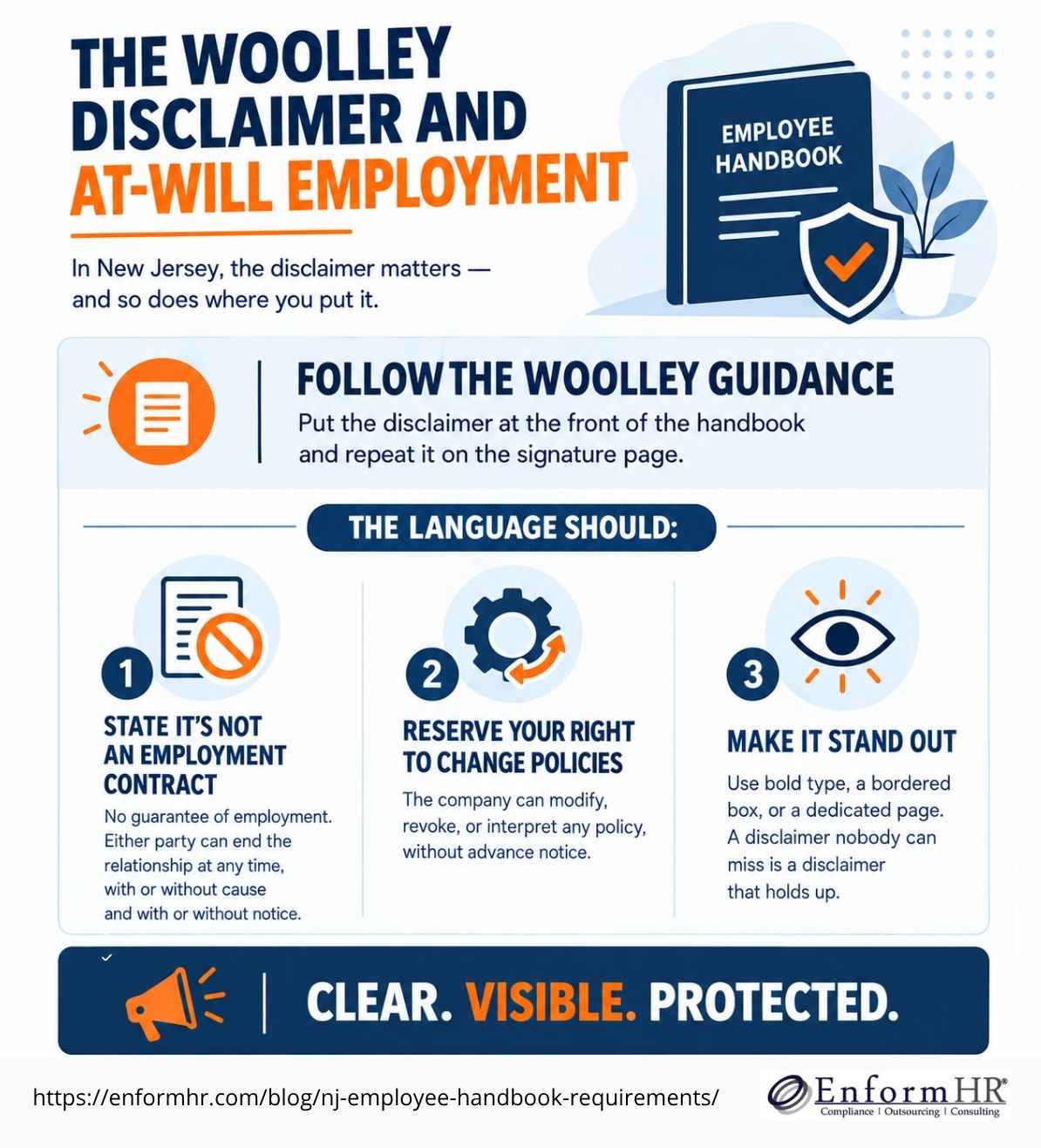
Every handbook should open with a disclaimer, and where you put it matters as much as what it says (Under Woolley, a disclaimer buried in small print on page fifty carries little weight). Your handbook should have an introductory page that:
- Boldly explains employment-at will.
- States that the handbook is not an employment contract.
- Reserves your right to change policies. T
- States that nothing in the handbook supersedes a contract or collective bargaining agreement or is intended to impede employees’ rights under the National Labor Relations Act (yes, even if you are not a union shop).
Progressive discipline language deserves a second look while you are in there. Listing steps such as verbal warning, written warning, suspension, and termination reads as a promise that you will follow them in order. State that the company may apply any level of discipline, or none, depending on the circumstances. Our guidance on the employee termination process covers how that plays out in practice.
Leave Policies Your Handbook Must Describe
Many states have leave policies, and these often overlap with federal regulations and even with the various state leave policies themselves. New Jersey, for example, layers several leave entitlements on top of each other, and employers explain to employees, and navigate, how they all fit together.
New Jersey Family Leave Act: More Changes in July 2027

This is the item most 2027 handbooks will get wrong. Governor Murphy signed A3451 in January 2026, and the amendments took effect on July 17, 2026, lowering the NJFLA employer threshold from 30 employees to 15 worldwide. The reductions continue on a phased schedule: 10 or more employees on July 17, 2027, and 5 or more on July 17, 2028.
Employee eligibility loosened at the same time. The old standard of 12 months of service and 1,000 hours worked dropped to three months and 250 base hours in the preceding 12 months. The Employers Association of New Jersey published an NJFLA expansion summary worth reading alongside your current policy.
Two more changes belong in your handbook. The amendments added a standalone reinstatement right for employees receiving Temporary Disability Insurance or Family Leave Insurance benefits. And employees now choose the sequence in which they use earned sick leave and TDI or FLI benefits, though they cannot use them at the same time. If your handbook currently requires concurrent use, that language is out of date.
Employers in the 10 to 14 headcount range should treat July 2027 as a deadline rather than a distant event. Building an NJFLA process from nothing takes policy drafting, manager training, notice distribution, and reinstatement protocols.
Earned Sick Leave Policy Language
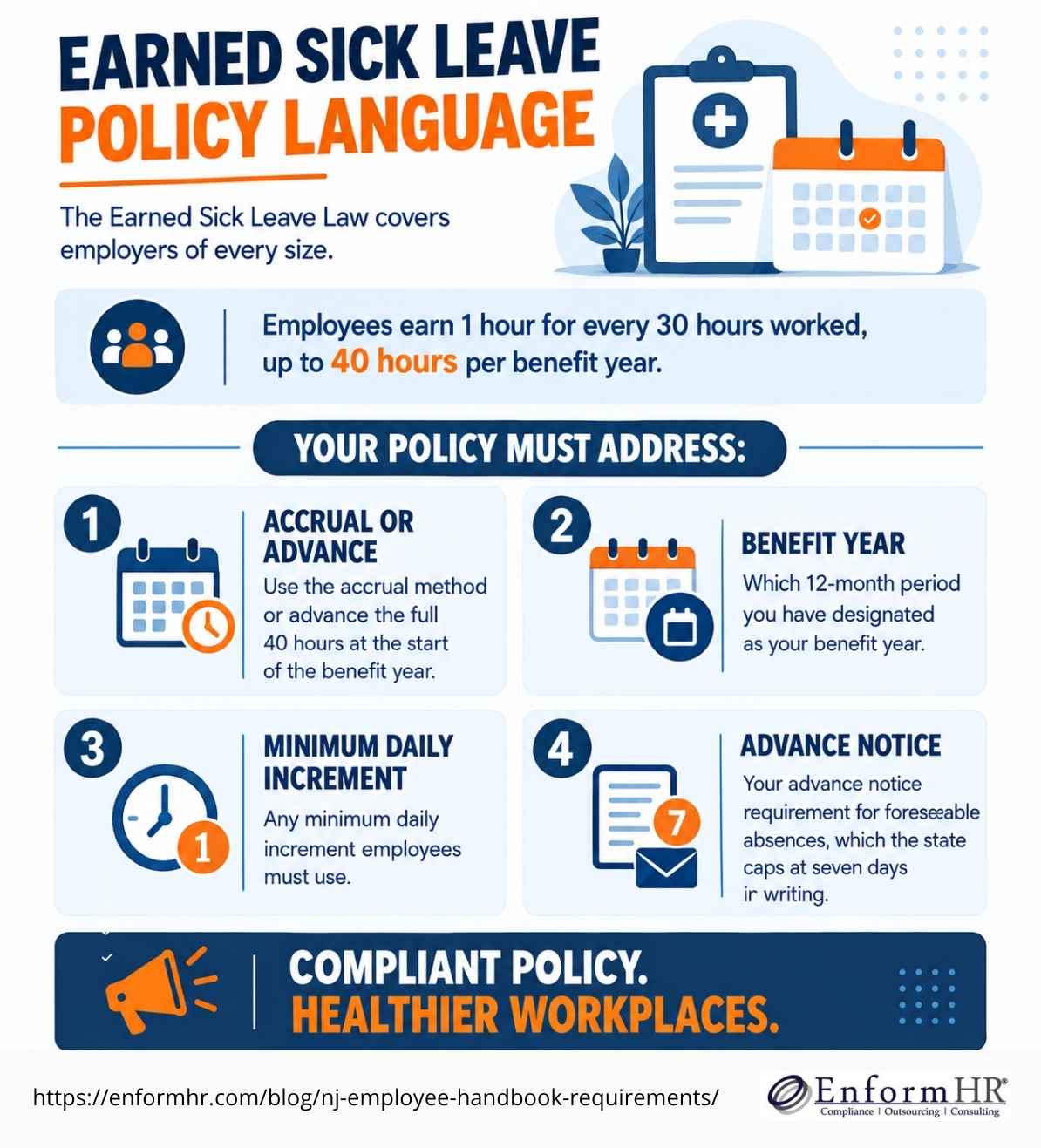
New Jersey’s Earned Sick Leave Law covers employers of every size. Employees are entitled to up to 40 hours of Paid Sick leave a year, and your written policy need to clarify several options the statute leaves to you, the employer:
- Whether you will have employees accrue their time (1 hour for every 30 worked) or front-load the 40 hours at the start of the benefit year.
- Which 12-month period you have designated as your benefit year.
- Any minimum daily increment employees must use.
- Your advance notice requirement for foreseeable absences, which the state caps at seven days in writing.
- Whether you will pay out earned but unused sick leave.
- If the unused hours carry over to the next benefit year (if accrued, they have to) and the maximum amount of hours you will permit employees to take in a benefit year (can’t be less than 40 but can be more).
New Jersey’s Department of Labor publishes earned sick leave guidance, including the rule that requirements apply only if you have put them in writing. A policy that stays silent on advance notice, for example, gives up the employer’s right to require it.
NJ SAFE Act Leave
An employer in New Jersey with 25 or more employees nationwide must provide up to 20 days of unpaid, job-protected leave for employees dealing with domestic or sexual violence affecting them or a family member. Your handbook policy should describe the regulation, examples of the reasons they can take leave, how employees and to whom they should request leave, the documentation you may request, and the confidentiality employees can expect from the company.
Wage and Hour Policies
Most states adjust their minimum wages annually based on Consumer Price Index data, and the Department of Labor publishes the new rate by September 30 for the January 1 effective date. The minimum wage in New Jersey for 2026 is $15.92 per hour for most employees and $15.23 for seasonal. Since the minimum wage changes regularly and varies by state, your handbook shouldn’t list the exact amount. Instead, it should state the non-exempt employees are eligible to earn overtime in accordance with state and federal regulations. You can state what hours qualify for overtime, such as over 40 hours worked in a week, but note that this can vary by state (For example, California is over 40 hours worked in a week and over 8 hours in a day). Your policy should also state that they must obtain approval, and from whom, prior to working any overtime.
Expense reimbursement deserves specific attention. The Appellate Division has treated unreimbursed business expenses as a potential source of liability under the New Jersey Wage Payment Law, so spell out how employees submit expenses and what your turnaround time is on processing reimbursements. You should also have a policy on breaks and whether or not they are paid and contribute the calculation of hours worked for the purposes of overtime eligibility.
NJLAD, Pay Transparency, and Dress Codes
The New Jersey Law Against Discrimination is more comprehensive that federal employment regulations and applies to employers with even a single employee in New Jersey.
The Division on Civil Rights, part of the NJ Attorney General, applies NJLAD protections to employees of New Jersey businesses who work in other states. A handbook that provides protections to protected classes under the NJ LAD to only employees who work in New Jersey does not adhere to the statute.
Gender-specific dress codes create exposure under the NJLAD. Write appearance and grooming standards in gender-neutral terms, describing what the role requires rather than what men and women should wear.
Pay transparency obligations apply to New Jersey (as well as some other states, line NY and CA) employers with 10 or more employees over 20 or more calendar weeks. Job postings and internal promotion opportunities disclose the salary range and a general description of benefits. Your handbook should describe how internal openings get posted so the practice matches the policy.

Cannabis Testing Under CREAMMA
The Cannabis Regulatory, Enforcement Assistance, and Marketplace Modernization Act changed what a positive test means in New Jersey. An employer cannot take adverse action against an employee based only on a positive test for cannabis metabolites, since those metabolites linger long after any impairment has passed (Note: this issue gets more complicated in the manufacturing sector and for those with CDL licenses, as the cannabis is currently illegal on the federal level, which can impact workers comp coverage.
Update your Drug and Alcohol policy to prohibit impairment during working hours. Describe what reasonable suspicion looks like, who is trained to observe and document it, what physical evaluation accompanies the test, and which safety-sensitive roles carry additional requirements.
Acknowledgment Forms and Annual Review
The last page of the handbook should have an Employee Acknowledgement that employees sign stating that they have read and received the handbook. It also reiterates the employment-at-will statement and the caveats mentioned in the introductory paragraphs at the beginning of the handbook. Upon receipt of the handbook and with each change, employees should sign the acknowledgement, and employers should file these in the employee’s personnel file.
These signed acknowledgments are what turn a handbook into usable evidence when an employee claims they never knew about the policy they are violating. With a signed acknowledgement, an employer defending a disciplinary action or termination can show the employee received the policy and knew what the standard was.
We’re often asked how to distribute the handbook. We recommend HR presents the handbook to employees, providing a brief overview of each policy and then distributes the policy to employees, giving them a few business days to read the handbook and sign and return the acknowledgement. Distribution depends on the business. If your employees don’t have access to a company email or computer (as is often the case in manufacturing, for example), then we recommend printing it and handing out hard copies. If most cases, posting the handbook on a shared drive that employees can access or uploading to your HRIS system works well.
Keep the signed acknowledgments with the personnel file and hold them for the length of the employment relationship plus your standard retention period. Consistent enforcement matters as much as consistent distribution, which is why the discipline and termination process should trace back to specific handbook language every time.
Review the whole document annually, and issue an addendum whenever a statute changes mid-year. Train supervisors on what changed, since a revised policy applied inconsistently across departments creates its own claim. A scheduled HR audit is the usual mechanism for catching drift between the handbook and actual practice.
Key Takeaways
- Place a bold Woolley disclaimer at the front of the handbook and repeat it on the signature page, and remove language that promises specific disciplinary steps.
- The NJFLA threshold drops to 10 employees on July 17, 2027, and to 5 on July 17, 2028, so employers in that range should start building the policy now.
- Employee eligibility for NJFLA leave is now three months of service and 250 base hours, down from 12 months and 1,000 hours.
- Your earned sick leave policy has to state the benefit year, the accrual or advance method, and any notice requirement, since unwritten requirements are unenforceable.
- Write dress codes in gender-neutral terms and scope anti-discrimination policies to cover remote employees working outside New Jersey.
- Base cannabis testing on documented impairment during working hours rather than on a positive metabolite result.
Talk to EnformHR About Your Handbook
EnformHR acts as an extension of your team. We draft and revise handbooks around how your business runs day to day, assist with the statutory language New Jersey requires, and train your managers to apply the policies the same way across every department, whether that runs as a one-time project or as part of ongoing outsourced HR support. Contact us to schedule a free consultation and talk through your current handbook, your headcount, and what needs to change ahead of the July 2027 leave threshold.

Recent Posts
Fractional HR vs. Outsourced HR vs. PEO: A Guide for Growing Employers