
At-Will Employment in NJ: The Exceptions That Get Employers Sued

The Costly Illusion of At-Will Employment in New Jersey
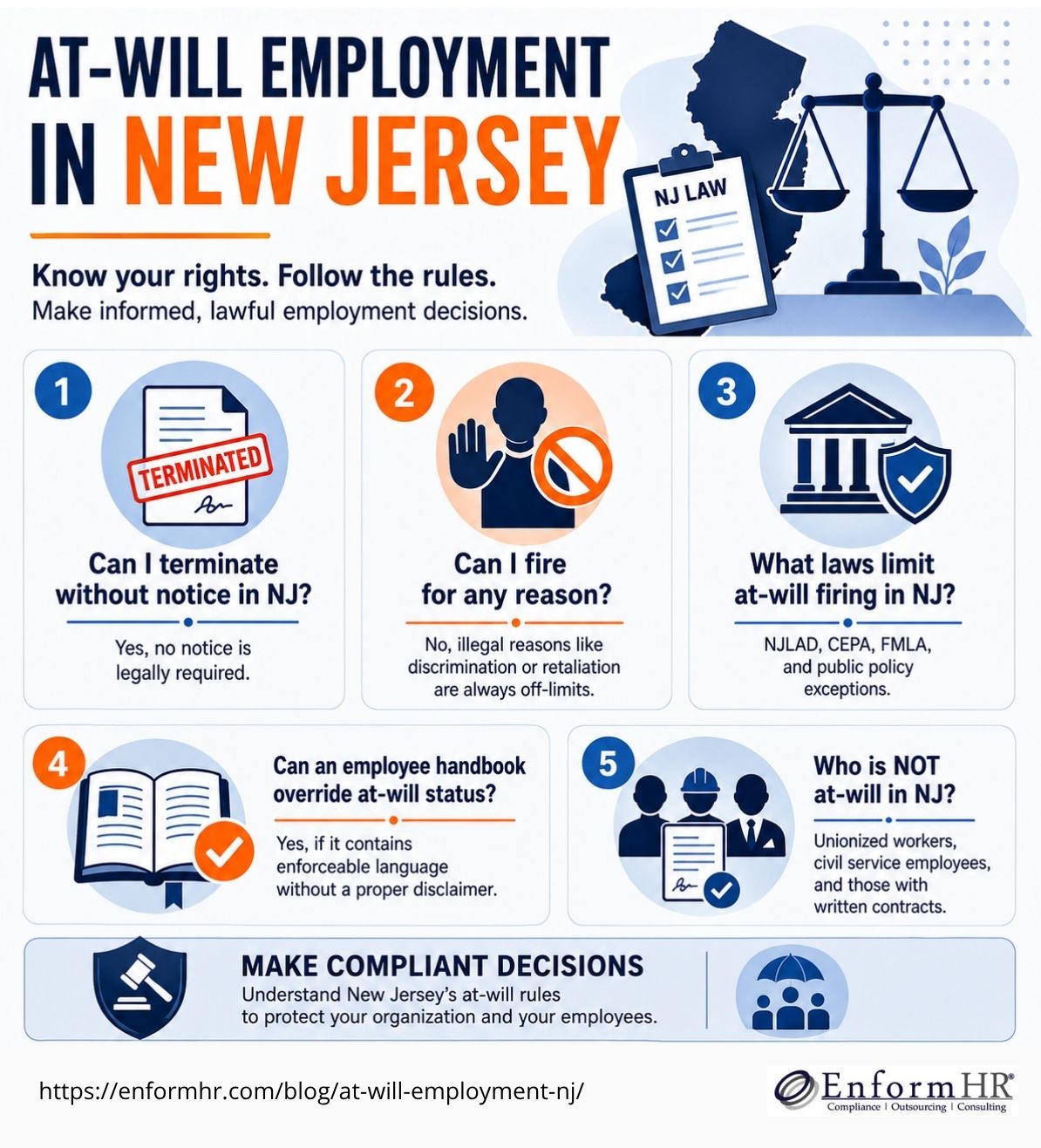
At-will employment in NJ means that either you or your employee can end the working relationship at any time, for any reason or no reason at all, without advance notice. But here’s what catches most employers off guard:
“At-will” does NOT mean “fire anyone, anytime, for anything.”
Here’s a quick summary of what you need to know:
| Question | Answer |
|---|---|
| Can I terminate without notice in NJ? | Yes, no notice is legally required |
| Can I fire for any reason? | No, illegal reasons (discrimination, retaliation) are always off-limits |
| What laws limit at-will firing in NJ? | EEO, NJLAD, GINA, CEPA, FMLA, and public policy exceptions |
| Can an employee handbook override at-will status? | Yes, if it contains enforceable language without a proper disclaimer |
| Who is NOT at-will in NJ? | Unionized workers, civil service employees, and those with written contracts |
The problem is that many employers believe at-will employment gives them unlimited freedom to terminate. It doesn’t. And that misunderstanding is exactly what leads to expensive wrongful termination lawsuits.
New Jersey has some of the strongest employee protection laws in the country. The New Jersey Law Against Discrimination (NJLAD) alone covers over 20 protected characteristics. Add whistleblower protections, implied contract law, and public policy exceptions and the legal minefield grows fast.
This guide focuses strictly on the legal boundaries and exceptions to at-will employment in New Jersey. For help establishing clear workplace rules, see our Employee Handbook Services page. To resolve an ongoing employee complaint safely, review our Workplace Investigations Service.
Understanding At-Will Employment and Its Legal Boundaries
At its core, the default employment relationship in New Jersey is built on the at-will doctrine. Approximately 90% of private-sector employees in the United States are considered at-will. In New Jersey, this means that unless a written employment contract, union agreement, or civil service regulation says otherwise, the relationship can be dissolved by either party at any time.
Under the standard state and federal compliance guidelines for New Jersey at-will employment, employers are not required to provide advance notice or a formal reason for a discharge. However, this flexibility is a double-edged sword. While it sounds incredibly permissive, the reality is that the “at-will” label provides zero protection if a terminated employee can connect their firing to a legally protected status or activity.
When we partner with local businesses through our HR Compliance Services, we emphasize that at-will status is merely a starting presumption. In the eyes of New Jersey courts, that presumption can be easily chipped away by state statutes, federal oversight, and common-law exceptions.
The Statutory Shield: How the NJLAD Limits Firing Rights
If at-will employment is the rule, the New Jersey Law Against Discrimination (NJLAD) is the ultimate exception. Codified under New Jersey Revised Statutes Section 10:5-12 (2025), the NJLAD makes it strictly unlawful to make employment decisions—including termination, demotion, or compensation cuts—based on protected characteristics.
These protected classes in New Jersey are far broader than federal baselines and include:
- Race, creed, color, and national origin
- Age, ancestry, and nationality
- Sex, gender identity, and gender expression
- Pregnancy, breastfeeding, and marital or domestic partnership status
- Affectional or sexual orientation
- Physical or mental disability
- Genetic information or blood traits
- Liability for service in the Armed Forces of the United States
Even if you terminate an employee without giving a reason (as at-will employment technically allows), a court will look at the circumstantial evidence. If an employee is fired shortly after disclosing a pregnancy or requesting a disability accommodation, the burden shifts to the employer to prove the termination was based on legitimate, non-discriminatory business reasons. This is why having objective, structured processes managed by professionals is vital something we handle daily through our HR services.
Implied Contracts: How Employee Handbooks Can Override At-Will Status
One of the most surprising ways New Jersey employers lose their at-will protection is through their own written materials. Under the landmark New Jersey Supreme Court ruling in Woolley v. Hoffmann-La Roche (1985), an employee handbook can inadvertently create an “implied contract.”
If your handbook contains a progressive discipline policy (e.g., “Employees will receive a verbal warning, then a written warning, followed by suspension, before termination”) without a prominent, clear, and unambiguous disclaimer, a court may rule that you have waived your right to fire that employee at-will. The law assumes that if you distribute a manual detailing job security or specific termination procedures, your employees have a reasonable expectation that those policies will be followed.
To preserve the at-will status of your team, your handbook must feature an explicit, bold disclaimer on the very first page (and ideally on a signed acknowledgment form). This disclaimer must state that the handbook is not a contract, does not guarantee employment for any specific duration, and that the employer reserves the right to terminate employment at any time, with or without cause or notice.
We specialize in helping businesses review and draft these critical documents through our Employee Handbook Services and often share insights on what to look out for in our guide on Policies to Include in an Employee Handbook.
Public Policy and Whistleblower Protections under CEPA
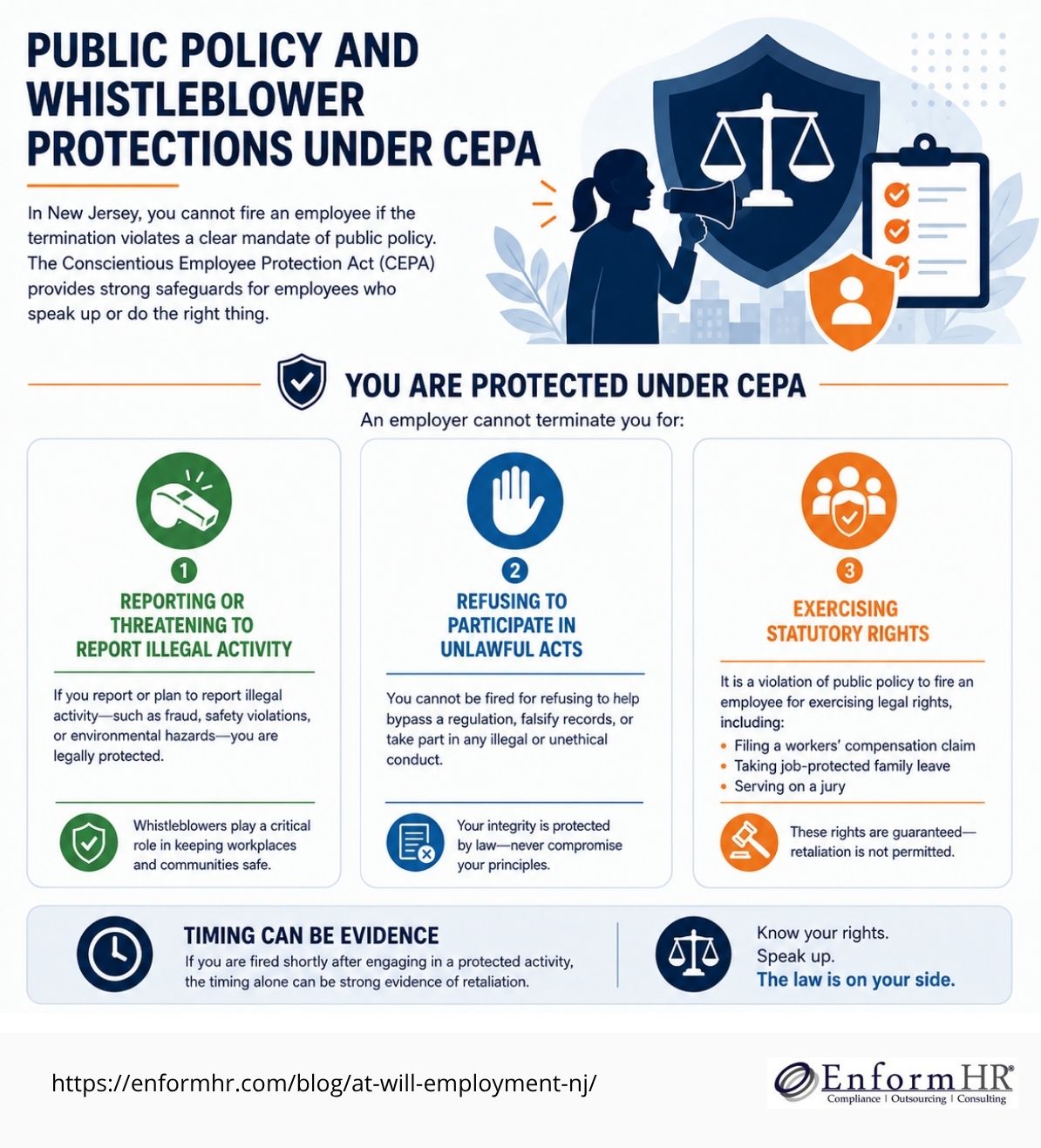
Even without a handbook issue or a discrimination claim, you cannot fire an employee in New Jersey if the termination violates a clear mandate of public policy. This exception is heavily reinforced by the Conscientious Employee Protection Act (CEPA), which is widely regarded as one of the most robust whistleblower protection statutes in the nation.
Under CEPA and New Jersey common law, an employer cannot terminate an at-will employee for:
- Reporting or threatening to report illegal activity: If an employee blows the whistle on fraudulent accounting, safety violations, or environmental hazards, they are legally protected.
- Refusing to participate in unlawful acts: You cannot fire an employee because they refused to help you bypass a state regulation or falsify business records.
- Exercising statutory rights: Firing an employee because they filed a workers’ compensation claim, took job-protected family leave, or performed jury duty is a direct violation of public policy.
When an employee is terminated shortly after engaging in any of these protected activities, the timing alone can serve as strong evidence of retaliation. For a deeper look at how these rules function in court, you can review the legal precedents surrounding New Jersey at-will employment.
Common Misconceptions: Can You Fire an Employee for Any Reason?
Many business owners believe that “any reason” truly means any reason. In reality, a lawful termination must be rooted in legitimate, non-retaliatory, and non-discriminatory business factors.
If you terminate an employee for poor performance, chronic absenteeism, or violating company policy, those are acceptable reasons, but only if you can prove them. If you fire an employee using “restructuring” or “position elimination” as a cover-up for a discriminatory motive, you expose your business to a constructive discharge claim. Constructive discharge occurs when an employer deliberately creates working conditions so intolerable that a reasonable person would feel compelled to resign. In the eyes of the law, this is treated exactly like a wrongful firing.
To clarify the boundaries, here is a comparison of lawful vs. unlawful termination reasons under New Jersey law:
| Examples of Lawful Termination Reasons | Examples of Unlawful (Actionable) Termination Reasons |
|---|---|
| Documented poor performance with objective feedback | Sudden firing after disclosing a pregnancy |
| Repeated violations of clearly communicated company policies | Termination for refusing to perform an illegal task |
| Elimination of a role due to genuine economic restructuring | Firing a worker for filing a workers’ comp claim |
| Chronic absenteeism violating attendance policies | Retaliation for reporting safety hazards to OSHA |
| Insubordination or abusive behavior in the workplace | Constructive discharge via targeted harassment |
Actionable Steps for Employers to Mitigate Wrongful Termination Risks
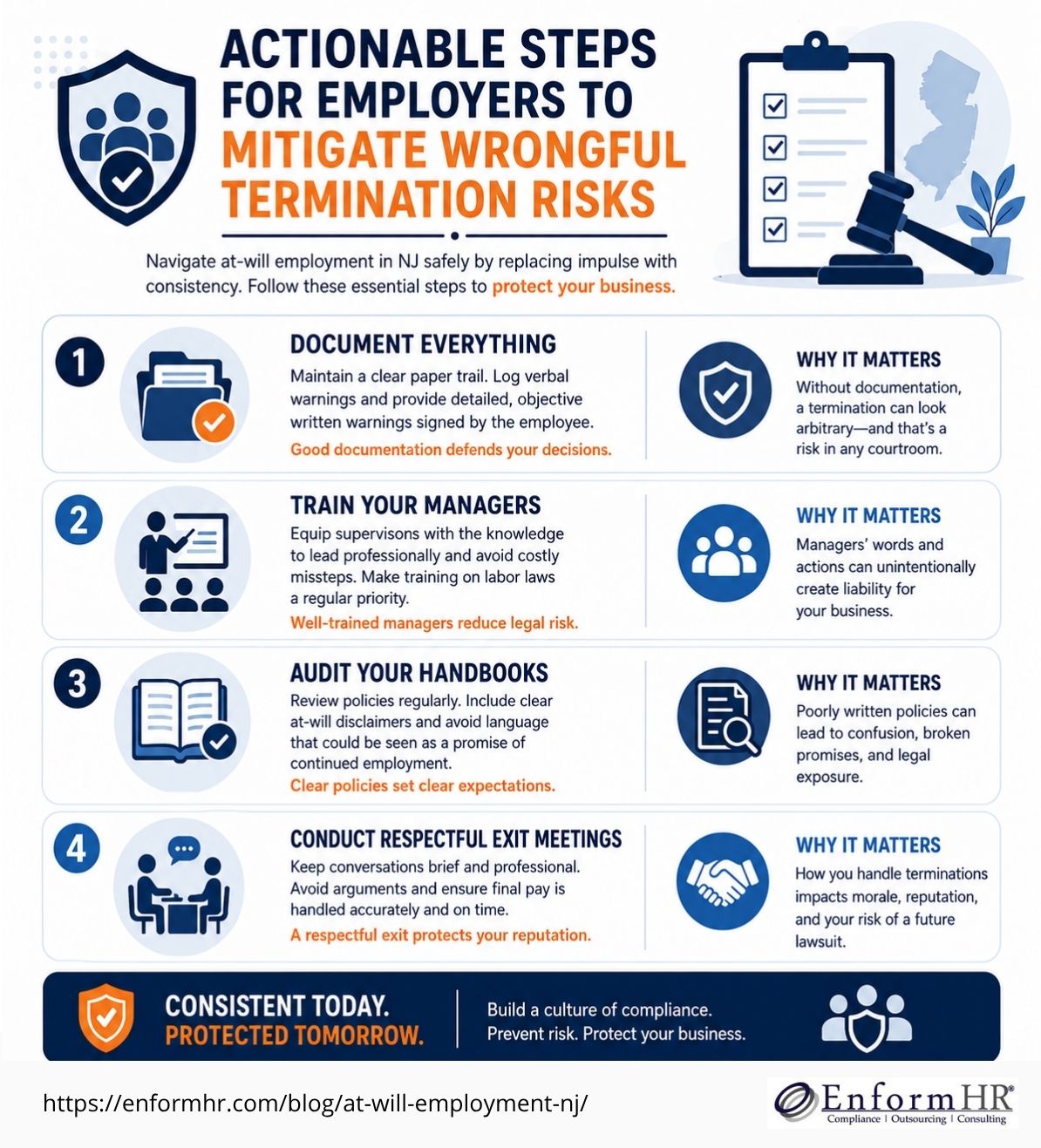
To navigate at-will employment in NJ safely, employers must move away from impulsive decision-making and adopt a culture of consistent compliance. Here are the essential steps we recommend to keep your business out of court:
- Document Everything: If an employee’s performance is slipping, write it down. Verbal warnings should be logged. Written warnings should be detailed, objective, and signed by the employee. Without a paper trail, a termination looks arbitrary, and in court, arbitrary often looks discriminatory.
- Train Your Managers: Your front-line supervisors are your biggest liability. If a manager makes an offhand comment about an employee’s age or complains about their medical leave, they have just handed that employee a lawsuit. Regular training on state labor laws and New Jersey employment regulations is vital.
- Audit Your Handbooks: Ensure your handbooks contain prominent at-will disclaimers and do not make accidental promises of lifetime employment or rigid progressive discipline without flexibility.
- Conduct Respectful Exit Meetings: How you treat someone on their way out matters. Keep termination meetings brief, professional, and objective. Avoid arguing, and ensure their final paycheck is processed in accordance with New Jersey state laws.
Essential Termination Documentation Checklist
Before you conduct a termination meeting, ensure you have gathered the following:
- Signed employee handbook acknowledgment form showing they received the at-will policy.
- Performance evaluations and documented disciplinary warnings showing a history of issues.
- Clear evidence of the specific policy violation or performance failure that triggered the firing.
- A prepared final paycheck (which must be paid by the next regular payday under NJ law).
- A written termination letter outlining the logistics (benefits, return of company property).
Key Takeaways:

At-will employment is not a magic shield that protects New Jersey businesses from legal claims. In a state with some of the most employee-friendly regulations in the country, relying solely on the “at-will” label is a recipe for a costly court battle.
- At-Will is the Default, Not a Guarantee: You can fire an employee without notice, but never for discriminatory or retaliatory reasons.
- Handbooks Can Create Contracts: Without a prominent disclaimer, progressive discipline policies can legally bind you, stripping your at-will rights.
- Whistleblowers are Heavily Protected: The Conscientious Employee Protection Act (CEPA) makes it illegal to terminate employees who report or refuse to participate in unlawful acts.
- Documentation is Your Best Defense: Always maintain a paper trail of objective performance issues and signed warnings to prove a termination was legitimate.
Are you unsure if a termination is legally safe? Before you let an employee go, ensure you aren’t walking into a wrongful termination lawsuit. The certified HR experts at EnformHR can help you assess the risk and execute a compliant exit strategy. Contact us today for professional guidance.

Recent Posts

Workplace Violence Prevention Training: An Employer’s Obligations