
Workplace Violence Prevention Training: An Employer’s Obligations

Why Proactive Workplace Safety Protocols Are No Longer Optional
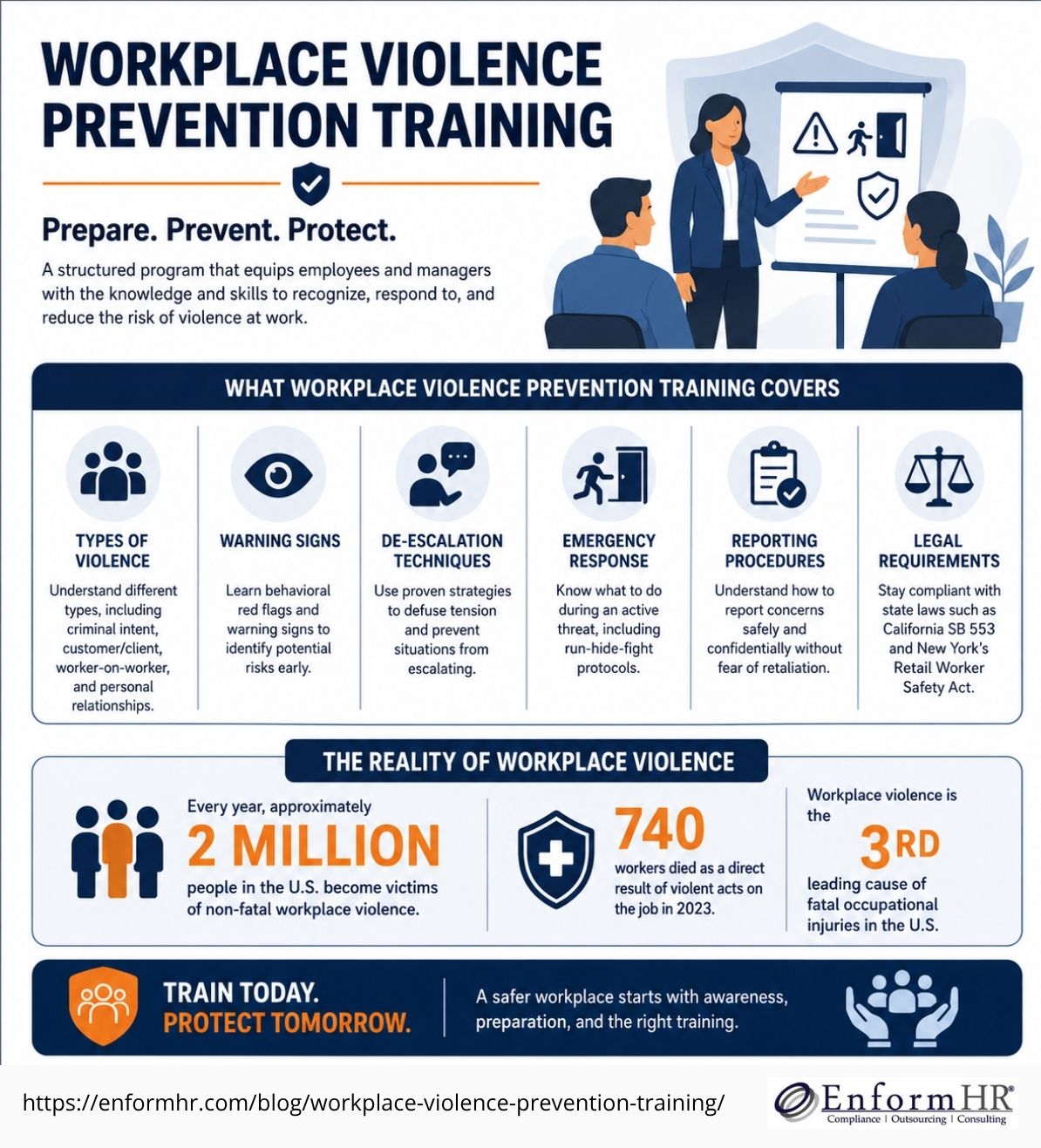
Workplace violence prevention training is a structured program that teaches employees and managers how to recognize, respond to, and reduce the risk of violence at work. Here’s what it typically covers:
- Types of workplace violence (criminal intent, customer/client, worker-on-worker, personal relationships)
- Warning signs and behavioral red flags to watch for
- De-escalation techniques to defuse tense situations
- Emergency response protocols, including run-hide-fight for active threats
- Reporting procedures and how to use them without fear of retaliation
- Legal requirements by state, including California SB 553 and New York’s Retail Worker Safety Act
Every year, approximately 2 million people in the United States become victims of non-fatal workplace violence. In 2023 alone, 740 workers died as a direct result of violent acts on the job, making workplace violence the third-leading cause of fatal occupational injuries in the country.
Those numbers are sobering. But here’s what makes them worse: most incidents don’t come out of nowhere. There are almost always warning signs. And yet, many employers still have no formal plan in place — no training, no reporting system, no response protocol.
That gap isn’t just dangerous. In states like California, it’s also illegal.
As of July 1, 2024, California employers are required by law to implement a written Workplace Violence Prevention Plan and provide annual employee training. Other states, including New York and New Jersey, have followed with their own mandates. And federal agencies like OSHA continue to increase pressure on employers across every industry.
The message is clear: this is no longer a “nice to have.” It’s a core employer obligation — and the cost of ignoring it can be measured in lives, lawsuits, and lasting damage to your organization.
This compliance blueprint focuses strictly on state and federal regularities, hazard identification, behavioral red flags, and emergency de-escalation protocols. To integrate safety compliance into your primary company policies, view our Employee Handbook Services page. If you are dealing with active disciplinary tracking or post-incident management, see our Discipline and Termination Services. For auditing existing internal complaints or threats, explore our Workplace Investigations Service.
Understanding the Threat: Categories, Regional Mandates, and Operational Vulnerabilities
To build a truly secure workplace, we must first understand what we are protecting our teams against. According to the Workplace Violence Overview – Occupational Safety and Health Administration guidelines, workplace violence is defined as any act or threat of physical violence, harassment, intimidation, or other threatening disruptive behavior that occurs at the work site.
As employers, we carry a legal and moral duty to provide a safe work environment. Failing to address these hazards doesn’t just damage company morale; it exposes organizations to severe liability, OSHA citations, and costly litigation. To effectively manage these risks, we must categorize the threats, understand regional legal mandates, and identify environmental and behavioral hazards.
Defining the Four Operational Categories
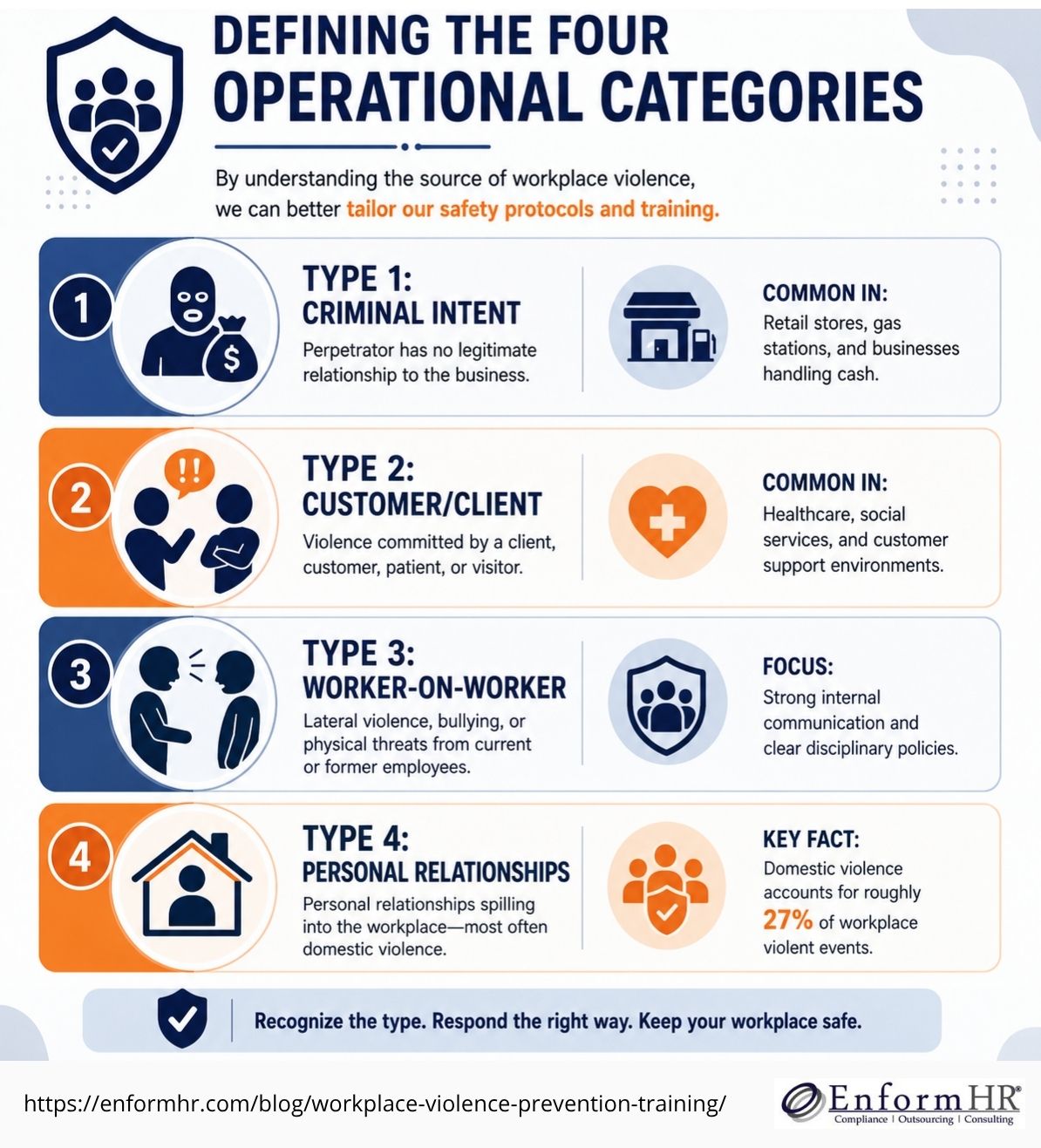
By breaking workplace violence down into four distinct categories, we can better customize our safety protocols and Training & Development programs:
- Type 1: Criminal Intent: The perpetrator has no legitimate relationship to the business. This is highly common in retail settings, gas stations, or businesses where cash is regularly exchanged.
- Type 2: Customer/Client: The violence is committed by a client, customer, patient, or visitor. This is a frequent hazard in healthcare, social services, and customer support environments.
- Type 3: Worker-on-Worker: This involves lateral violence, bullying, or physical threats from current or former employees. It underscores the critical need for robust internal communication and clear disciplinary policies.
- Type 4: Personal Relationships: This occurs when a personal relationship spills into the office—most notably through domestic violence. Statistics show that domestic violence accounts for roughly 27% of violent events in the workplace. We must train managers to support victims and secure the physical premises when personal threats are identified.
Legal Compliance: SB 553, Labor Code 6401.9, and State Mandates
State-level enforcement has grown significantly more stringent over the last several years.
- California (SB 553 & Labor Code 6401.9): Effective July 1, 2024, nearly all California employers must implement a written Workplace Violence Prevention Plan (WVPP) and deliver annual training to their teams. Resources like the Cal/OSHA Workplace Violence Prevention for General Industry (Non-health Care Settings) page provide model plans, but employers must customize these to their specific worksites.
- New York: The Retail Worker Safety Act mandates that retail employers adopt comprehensive violence prevention policies and conduct interactive de-escalation and active shooter training.
- New Jersey: For employers in our home state of New Jersey, compliance is highly regulated in specific sectors. Under N.J. Admin. Code § 8:43E-11.10 – Violence prevention training, healthcare and specific public facilities must run structured, annual violence prevention programs. Even for general industries in NJ, maintaining a proactive compliance posture is vital to meeting federal OSHA General Duty Clause expectations.
Identifying Hazards and Recognizing Behavioral Warning Signs
Preventing an incident starts with a thorough worksite hazard assessment. We recommend evaluating physical risk factors such as poor lighting, isolated work areas, lack of physical barriers at reception desks, or unsecured entry points.
Equally important is teaching our workforces to recognize behavioral red flags. Violence rarely occurs without warning; it typically escalates through predictable stages:
- Level One (Early Warning): Uncooperative behavior, verbal abuse, constant complaining, and aggressive language.
- Level Two (Escalation): Argumentative behavior, blatant refusal to follow policies, verbal threats, and self-destructive habits—which are often closely linked to substance abuse indicators like slurred speech, sudden mood swings, or coordination issues.
- Level Three (Crisis): Physical altercations, destruction of property, brandishing weapons, or explicit threats of severe harm.
Early intervention not only defuses immediate threats but also fosters a culture of mutual respect, which is a key component of Preventing Discrimination in the Workplace.
Implementing an Effective Safety and Mitigation Program
Simply handing your team a generic, off-the-shelf safety manual does not satisfy your legal or ethical obligations. To be truly effective, a workplace violence prevention training program must be interactive, engaging, and customized to your specific workplace hazards. We must involve employees in the design process to ensure the training addresses the real-world scenarios they face daily.
Core Components of a Compliant Workplace Violence Prevention Plan (WVPP)
A compliant written plan must serve as an active, operational roadmap. It should outline:
- Clear Roles and Responsibilities: Define what is expected of managers, supervisors, HR, and employees.
- Retaliation-Free Reporting: Establish multiple, highly accessible channels for employees to report concerns or threats without fear of professional consequences.
- Integration with Workplace Harassment Policies: Aligning your physical safety protocols with comprehensive Avoid Litigation & Protect Your Reputation with Workplace Harassment Training creates a unified compliance framework that protects both your employees and your brand.
De-escalation Techniques and Emergency Response Protocols
The heart of any training program lies in teaching practical, physical, and verbal skills.
Verbal De-escalation and Body Language
Employees should be trained in verbal de-escalation techniques to defuse tense situations before they turn physical. This includes maintaining a calm tone of voice, using non-threatening body language (keeping hands open and visible, respecting personal space), and practicing active listening. These practices mirror the core concepts found in our favorite Conflict Management Examples.
Emergency Response and Active Shooter Preparedness
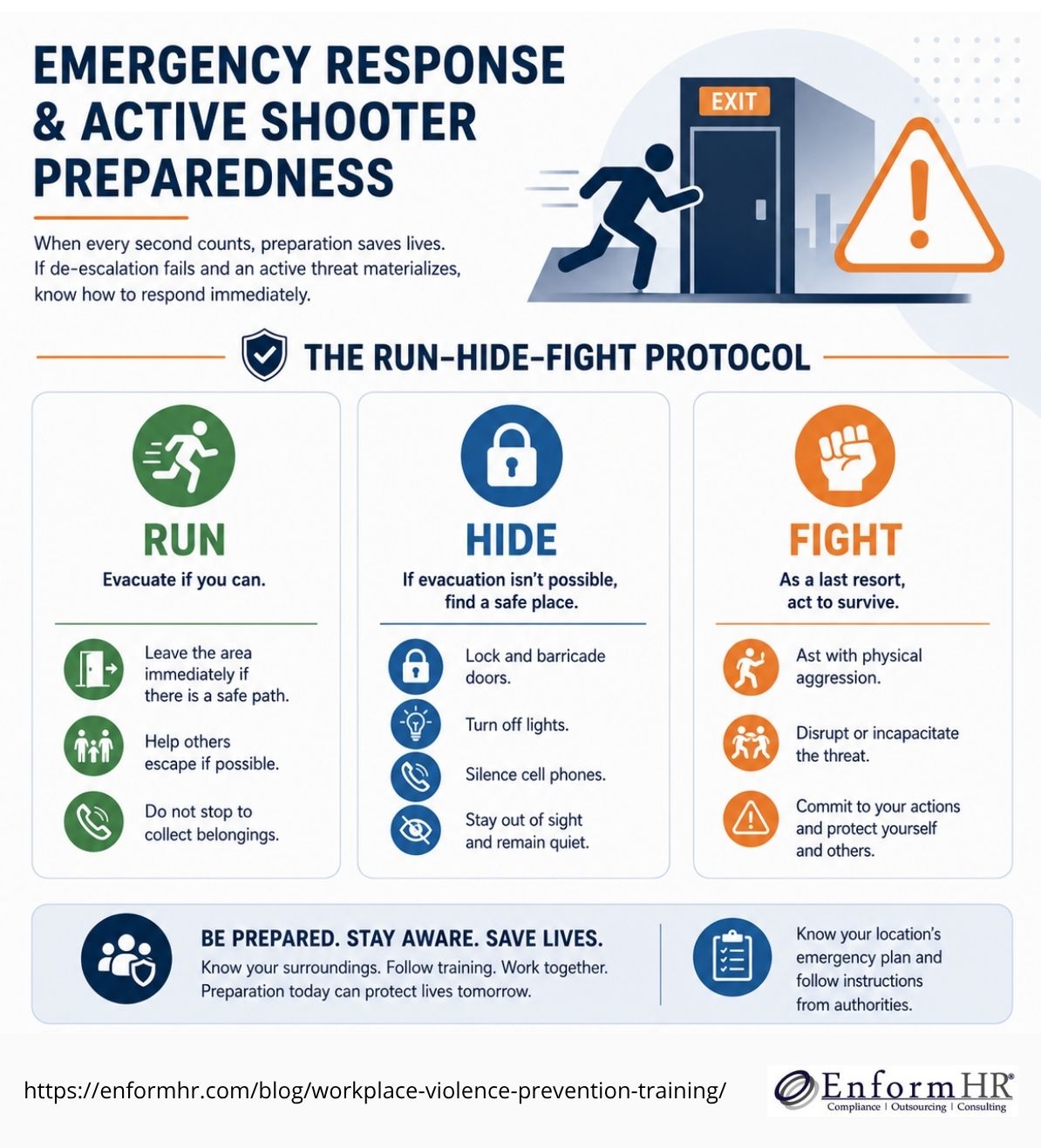
If de-escalation fails and an active threat materializes, employees must know how to execute emergency response procedures immediately. Training should cover the industry-standard Run-Hide-Fight protocol:
- Run: Evacuate the area immediately if there is a safe path.
- Hide: If evacuation is impossible, lock and barricade doors, turn off lights, silence cell phones, and stay out of sight.
- Fight: As an absolute last resort, if your life is in imminent danger, act with physical aggression to disrupt or incapacitate the threat.
Post-Incident Response, Recordkeeping, and Scaled Program Customization
What happens after an incident is just as critical as the prevention steps. Employers must have post-incident response procedures in place, including offering immediate access to Employee Assistance Programs (EAP) and trauma-informed mental health support.
Additionally, thorough recordkeeping is a legal necessity. Under federal and state guidelines, we must maintain:
- Detailed training logs (typically kept for at least one year).
- Violent incident logs and hazard assessment records (typically kept for a minimum of five years).
- Post-incident investigation reports.
Finally, customized training is the only training that works. A multi-location business cannot rely on a single template. A retail store in New York, a warehouse in New Jersey, and a corporate office in California all face entirely different risk profiles. Your training must be tailored to these specific environments and translated into the primary languages spoken by your diverse employee populations.
Key Takeaways: Building a Compliant and Safe Workplace
Mitigating risk and meeting state safety mandates requires moving past static paperwork and establishing a continuous culture of awareness, clear reporting metrics, and active de-escalation skills.
- Understand Local Legislation: Explicit laws like California SB 553, New York’s Retail Worker Safety Act, and New Jersey healthcare provisions mandate structured training. General industries must also align with federal OSHA General Duty Clauses to avoid severe liabilities.
- Acknowledge Behavioral Red Flags: Threats rarely materialize without precursors. Staff must be trained to identify and log early level-one warnings (verbal abuse, erratic disruption) before they slide into crisis.
- Establish Multi-Channel Reporting: Ensure that employees have highly accessible, clear paths to report toxic behaviors or safety concerns anonymously and completely free from professional retaliation.
- Rely on Meticulous Recordkeeping: Maintain interactive log files for at least one year and preserve violent incident tracking data or structural hazard assessments for a minimum of five years to ensure compliance.
Do your current safety protocols meet changing state and federal compliance laws?
Don’t wait for a costly compliance penalty or an unmanaged workplace risk to compromise your organization. The credentialed professionals at EnformHR are here to help you audit your existing workplace policies, draft custom mitigation roadmaps, and implement safe interactive education formats across your regional locations.
Contact EnformHR today to secure your workforce compliance framework.

Recent Posts
Exit Interviews: Benefits, Questions, and How to Act on the Data